UK Open Mic Nights: How to Test New Lyrics in Front of an Audience

You have a new lyric. It reads well on the page, but you do not know if it lands when sung. The quickest way to find out is to stand in front of a room of strangers with a microphone and no safety net. UK open mic nights are full of these rooms — pubs, cafes, church halls, small arts centres — and they are the best free testing ground for lyrics you will find.
Not every open mic is a listening room. Some are loud, some are comedy-first, some are covers-only. If you want honest feedback on your words, choose a night where the audience has come for the songs. Look for listings on local music Facebook groups, venue noticeboards, and the websites of small arts centres. Word of mouth still works best: ask other songwriters where they go to try new material.
Before you travel, check the basics. A quick message to the host will save you a wasted evening.
If the answers suggest a quiet, attentive room, you have found your workshop. If the room is noisy, you can still perform, but do not expect reliable feedback on a subtle line.
Pick two or three songs. One can be familiar, to settle your nerves, but the rest should be new. The point is to test, not to impress. Put the song you most want feedback on second, after you have warmed up.
Practise the lyrics without any accompaniment. Read them aloud. If a phrase is hard to say, it will be hard to hear. Slow down. Open your mouth. Do not swallow the ends of lines. Record yourself on your phone and listen back for mumble spots.
Keep the arrangement sparse. A single guitar, a piano, or nothing at all. Busy fingerpicking competes with the voice. If you play with others, ask them to play quietly and leave space. Print your lyrics in large type and put them where you can see them. Using a lyric sheet at an open mic is not cheating; it is part of the test.
When you introduce a song, keep it short. “This one is new. I would love to know if the second verse makes sense.” That is enough. Do not apologise for new material. The audience is on your side.
Look up. You will learn more from faces than from applause. People lean in when a line grabs them. They look away when they are lost. A laugh at a funny line, a murmur at a specific image, a nod at a chorus — these are your data points.
Notice when the room goes quiet. Notice when someone stops talking. Notice when a phone comes out. If you forget a line, repeat the previous one or hum. The audience will not know, but you will remember where it happened. That is a clue that the line is not yet embedded in your memory.
Ask a friend to record the set and note reactions. One person, one job: watch the room, not just the applause. Polite clapping tells you little. The moments between songs tell you more. Did anyone repeat a line back to you afterwards? Did anyone ask what a particular phrase meant? Those are signs that a lyric has landed.
Wait until the next day before you change anything. Rewriting in the car park, still buzzing or bruised, rarely ends well. Listen back to the recording. Which words were unclear? Which lines got a laugh you did not intend? Which got silence when you expected a reaction?
Separate performance problems from writing problems. If you rushed, that is performance. If the image is abstract, that is writing. Test one change at a time. If a line falls flat, try a concrete noun instead of an abstract one. “I miss you” becomes “I still keep your coat by the door.” Small, specific details give the audience something to hold.
Keep a lyric journal. Write the date, the venue, and one note per song. “Verse two, line three: no reaction. Try swapping ‘shattered’ for ‘cracked’.” Next time you perform, see if the reaction changes. Do not chase every reaction. Some lines need to be quiet. A line that makes one person cry is worth more than a line that makes twenty people laugh if that is what the song needs.
You want to return to these rooms, so treat them well. Be ready when your name is called. Do not overrun your slot. Thank the sound engineer and the host. Buy a drink if you can. Stay for a few other acts and listen properly. Do not talk during someone else’s set.
Build relationships with the people who run the night. They will remember you, and they will give you a slot when you have new material to test. If you want feedback, ask a specific question afterwards: “Did the third verse make sense?” Not “Was it good?” Specific questions get useful answers.
The more you treat open mics as a workshop, the faster your lyrics improve. You will learn which lines carry, which need work, and how to trust a room. The song will tell you what it needs. Your job is to keep showing up and listening.
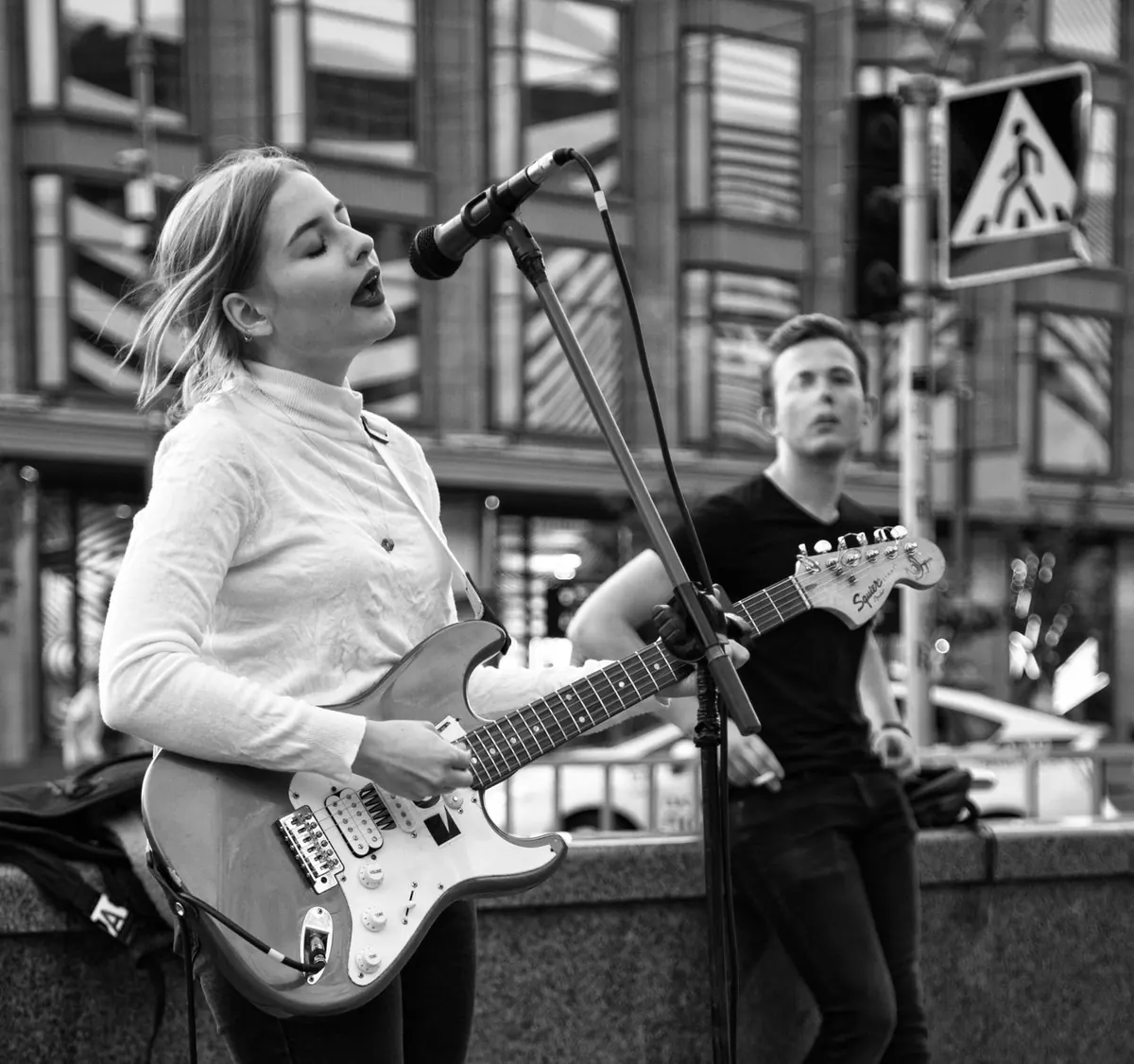
Photo: William Sutherland / Pexels
Previous Post
How to Write Festive Lyrics Without Clichés: A UK Christmas Song Guide
Next Post
How British Singer-Songwriters Turn Everyday Speech into Lyrics